

Canon entries 720
Selected 307
Filtered 307
Page 7/13

storymaking moves

Tools

Document, loop, beat, and slide-level techniques the matcher can attach to evidence.

307 entries 24 on this page
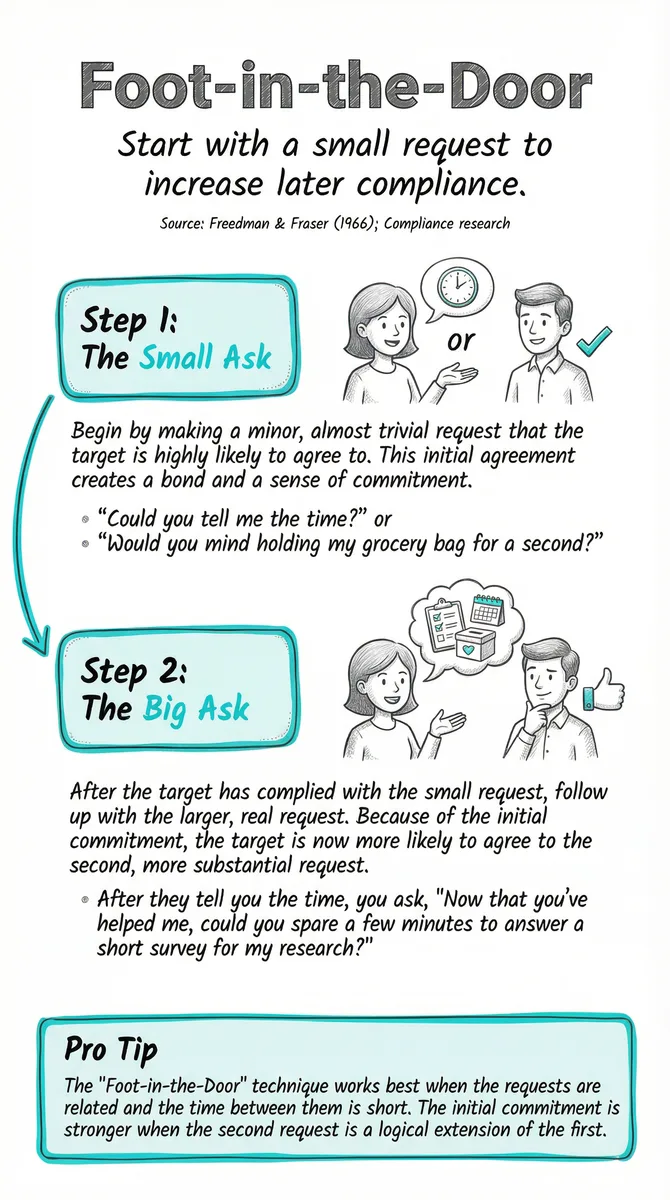
T Foot-in-the-Door illustration

Loop · loop

Foot-in-the-Door

foot-in-the-door
0 mixed-layer hits

Start with small request to increase later compliance

0 docs 0 slides/ranges n/a confidence
Storyteller
T Foreshadowing illustration

Loop · loop

Foreshadowing

foreshadowing
46 mixed-layer hits

Planting hints of what's to come for later payoff

40 docs 46 slides/ranges 70% confidence
Storyteller
Observed evidence

Sentence deliberately left dangling for next slide to complete

Plants GenAI and tech levers that the CEO agenda will pick up on p43.

Highlighted bars name the three case studies on pp.26-28.

T Goal Gradient Effect illustration

Loop · loop

Goal Gradient Effect

goal-gradient-effect
80 mixed-layer hits

Motivation increases as people approach their goal - show progress

70 docs 80 slides/ranges 34% confidence
Storyteller
Observed evidence

The slide mentions goals for reducing touches in the registration process.

The slide presents a clear goal (making it easy to do the right thing) and implies a sense of progress toward that goal.

Year-by-year milestones progressing toward 'Net Zero by 2050'

T Hindsight Bias illustration

Loop · loop

Hindsight Bias

hindsight-bias
3 mixed-layer hits

People overestimate their ability to have predicted events - acknowledge unpredictability

3 docs 3 slides/ranges 62% confidence
Storyteller
Observed evidence

Explicit callout: 'with hindsight, all risks are obvious'.

Callout reframes Q422 as 'record FICC comparator' to soften comp.

Old wrong forecast used to humble current forecasts

T Information Gap Theory illustration

Loop · loop

Information Gap Theory

information-gap-theory
84 mixed-layer hits

Curiosity arises from gap between what we know and want to know

77 docs 84 slides/ranges 68% confidence
Storyteller
Observed evidence

Opens loop by raising the AI-maturity question without answering.

Rhetorical question creates open loop closed by p8-11 evidence

Disconnect creates curiosity gap that following slides fill.

T Low-Ball Technique illustration

Loop · loop

Low-Ball Technique

low-ball-technique
0 mixed-layer hits

Get commitment first then reveal additional costs/requirements

0 docs 0 slides/ranges n/a confidence
Storyteller
T Optimism Bias illustration

Loop · loop

Optimism Bias

optimism-bias
5 mixed-layer hits

People overestimate likelihood of positive events - balance hope with realism

5 docs 5 slides/ranges 57% confidence
Storyteller
Observed evidence

Ends on optimism beat after sober macro opening

Frames the outlook with 'reasons for optimism' framing.

Pivots to upside despite reset framing.

T Payoff illustration

Loop · loop

Payoff

payoff
58 mixed-layer hits

Delivering on earlier setup for satisfying resolution

50 docs 58 slides/ranges 69% confidence
Storyteller
Observed evidence

Closes the parenthetical setup from p18

Final slide of cascade loop: pays off the targets recap with the investment thesis.

Pays off the 10-year setup with #1 leadership in 4 regions / 3 segments

T Peak-End Rule illustration

Loop · loop

Peak-End Rule

peak-end-rule
41 mixed-layer hits

Experiences judged primarily by their peak moment and ending

35 docs 41 slides/ranges 66% confidence
Storyteller
Observed evidence

Final loop deliberately structured as the memorable closing peak.

Final 'OUTLOOK' panel reasserts confidence as the lasting end note.

Closing PES section with crisp summary

T Sparklines illustration

Loop · loop

Sparklines

sparklines
4 mixed-layer hits

Emotional tension oscillation mapping between what is and what could be

3 docs 4 slides/ranges 49% confidence
Storyteller
Observed evidence

Two parallel time-series visualize emotional/strategic tension between two priorities.

Two emotional-tension lines (stock market vs economy) tracked over 30 months.

Timeline plots capability evolution 2008-2026 as a trajectory.

T Sunk Cost Effect illustration

Loop · loop

Sunk Cost Effect

sunk-cost-effect
0 mixed-layer hits

People reluctant to abandon situations they've invested in - acknowledge shared journey

0 docs 0 slides/ranges n/a confidence
Storyteller
T Tension Management illustration

Loop · loop

Tension Management

tension-management
43 mixed-layer hits

Planning emotional peaks and valleys throughout the narrative

41 docs 43 slides/ranges 64% confidence
Storyteller
Observed evidence

Stacking the odds against the protagonist makes the audience not only feel more empathy towards her, but it also makes a victory feel earned

Releases tension built up by the complication block

Opens loop 1 by raising geopolitical tension before resolving with opportunity

T The Turn illustration

Loop · loop

The Turn

the-turn
57 mixed-layer hits

Pivotal moment where perspective shifts or insight emerges

50 docs 57 slides/ranges 74% confidence
Storyteller
Observed evidence

Sets up the two-slide pivot with trailing ellipsis.

Pivotal slide where the strategic shift (spin-off) is announced.

Loop 5 anchored here — divider 'Customer experiences go back to the future' is the pivot beat

T Tricolon illustration

Loop · loop

Tricolon

tricolon
139 mixed-layer hits

Three parallel phrases of increasing length or intensity

101 docs 139 slides/ranges 76% confidence
Storyteller
Observed evidence

Callout names 'three imperatives' previewing the next three loops

'Three forces' framing across slides 3-4.

Four-clause cadence with rhythmic 'More/Less' pattern

T Zeigarnik Effect illustration

Loop · loop

Zeigarnik Effect

zeigarnik-effect
1 mixed-layer hits

Incomplete tasks are remembered better than completed ones - create open loops

1 docs 1 slides/ranges 65% confidence
Storyteller
Observed evidence

Deck ends on unresolved questions to keep readers engaged

T Action Titles illustration

Slide · slide

Action Titles

action-titles
13,944 mixed-layer hits

The McKinsey-bred discipline of writing every slide title as a complete declarative sentence with a verb and an insight, not a topic label. Each title is a sub-claim that ladders up to the deck's governing thought; read in sequence, the titles reconstruct the executive summary.

2,215 docs 13,809 slides/ranges 67% confidence
When to use
Any decision-grade deliverable — strategy recommendation, board update, investment memo, M&A review, post-mortem — where the reader is being asked to agree, decide, or act and will skim the title bar at speed.
Why it works
Solves two failure modes at once. (1) The buried claim: action titles place the conclusion on the page before any analysis is read, so a busy reader doesn't reverse-engineer it from the chart. (2) The spineless deck: because each title is a claim, slides have to ladder up to the governing thought; logical gaps become visible as topic-shaped titles in a sequence that no longer reads as a story.
Purpose
Forces the deck to carry its argument in the title bar so a senior reader can extract the recommendation without opening a single slide; converts a binder of topics into a navigable pyramid where every slide is a node defending the apex.
Anti-pattern
Topic labels disguised as titles — Volume by quarter, Key findings, Pricing strategy, Margins have been impacted. No verb, or a passive verb with no agent, or a fact (Revenue grew 12%) without the so-what. Also: titles that overreach the chart's evidence, multi-claim X-grew-but-Y-fell welded titles, and mechanical repetition of the same X-drove-Y template across the deck.
Architect titlecalloutsubtitle action titlekey takeawayin summarydrovedeliveredgrewdeclinedrecoveredrecommendationheadline
Observed evidence

'VCs remain vested in the region with $15B dry powder'

Title 'Expanding network effects' makes a directional claim.

Antero is the only publicly-traded Appalachian Basin company run by Co-Founders

T Core Message Extraction illustration

Slide · slide

Core Message Extraction

core-message-extraction
807 mixed-layer hits

The discipline of distilling raw analysis, data, or content into a single declarative sentence — the slide's core message — that the audience would walk away with if they remembered nothing else. Process, not artefact: extraction questions run on the raw content until one sentence falls out.

472 docs 804 slides/ranges 57% confidence
When to use
Any slide that carries an argument or finding. The diagnostic: if the slide has a chart on it, it needs a core message. Run extraction whenever the current title is a topic (Q3 performance, Customer satisfaction) rather than a claim, or when a reader could reasonably draw more than one conclusion from the visible evidence.
Why it works
Solves the two failure modes of slide writing simultaneously: the topic title (which outsources interpretation to the audience and produces three different conclusions in three different heads) and the multi-thesis stapler (which exceeds working memory and gets remembered as fragments). Aligns with how readers actually consume decks — Heath & Heath's Find the Core, the journalist's nut graf, and Minto's governing thought all converge on the same cognitive economics.
Purpose
Forces the slide author to do the interpretive work before the slide ships, so the audience does not have to do it during the meeting. Wins the WYSIATI battle on purpose — the loudest fragment on the page becomes the author's chosen sentence rather than whichever chart label happens to be largest.
Anti-pattern
Topic titles disguised as core messages (Customer satisfaction, no verb, no stake); multi-thesis sentences stapled with and; hedged sentences (may show signs of possible softening); chart-caption titles (Revenue fell 4%) that restate what the chart already shows instead of naming the so-what; meta-commentary (this slide explores...) that describes the slide rather than concluding it.
Architect titlecalloutsubtitleparagraphquote bottom linekey insightthe takeawayin essencein shortcore findingthe point istl;drnut graffind the corecommander's intentthe one thing
Observed evidence

The slide extracts the core message that SBTN guidelines are the key global reference for nature-related target setting.

In our AI Services practice, our teammates tag and annotate data sets to create the raw material that artificial intelligence is built on.

Full-slide quote distills core thesis: buy anything vs shop the way.

T Default Bias illustration

Slide · slide

Default Bias

default-bias
2 mixed-layer hits

People tend to stick with default options - make desired action the easiest path

2 docs 2 slides/ranges 60% confidence
Architect
Observed evidence

Single application path (email) is the default action

'No regret' framing positions actions as default-safe choices to take regardless.

T Defensive Design illustration

Slide · slide

Defensive Design

defensive-design
8 mixed-layer hits

Anticipating and designing for user errors and edge cases

8 docs 8 slides/ranges 46% confidence
Architect
Observed evidence

20+ GRANTED PATENTS

Lists mitigating actions explicitly.

paragraph/paragraph: Prompt injection remains one of the most persistent vulnerabilities in LLM-based systems, with current defenses relying on patchwork filtering or after-the-fact classifiers.

T Error Recovery illustration

Slide · slide

Error Recovery

error-recovery
0 mixed-layer hits

Designing for easy recovery from mistakes

0 docs 0 slides/ranges n/a confidence
Architect
T Headline Test illustration

Slide · slide

Headline Test

headline-test
39 mixed-layer hits

A three-question editorial test applied to any candidate slide title or headline: does it have a real verb, does it make a defensible claim, and would the reader walk away with the right point if they read only that line?

30 docs 39 slides/ranges 26% confidence
When to use
On every body slide title, every memo subject, every section header, every dashboard tile and every blog H1 — applied at draft time and again at review. Skip only on divider / agenda / neutral-framing navigation slides where the title is intentionally not summarising.
Why it works
The title is the only line statistically read by every reader (eye-tracking evidence from Nielsen Norman Group); a three-step filter on verb, claim, and memorability forces the analyst to commit to a finding rather than decorate the slide with a folder name, and catches the failure mode pyramid-MECE checks alone miss — clean ladders of invisible labels.
Purpose
Acts as the cheapest universal quality gate on every line of text whose job is to summarise what comes after it — converting topic-shaped labels into claim-shaped action titles so that a reader scanning only headlines reconstructs the argument.
Anti-pattern
Titles whose only verb is a copula (is, has, are), passive constructions hiding the agent, hedging adverbs that dilute the claim (may have somewhat softened), meta-descriptions (this slide shows...), bare numeric facts without a so-what, and topic labels masquerading as titles (Cost dynamics, Strategic implications).
Architect titlesubtitlecallout action titleheadlinesubheadgoverning thoughtso whatkickertopic titlepunchlineverb in the titlelede
Observed evidence

Single page lists every action title in the deck (6 trends + 8 implications).

The slide features a clear headline and action title, indicating consideration of headline testing.

With less waste

T Postel's Law (Robustness) illustration

Slide · slide

Postel's Law (Robustness)

postels-law-robustness
0 mixed-layer hits

Be conservative in what you send, liberal in what you accept

0 docs 0 slides/ranges n/a confidence
Architect
T So What? Test illustration

Slide · slide

So What? Test

so-what-test
728 mixed-layer hits

The recursive editorial discipline of asking so-what of every slide, chart, and statement until the answer is an implication for the audience — that final answer becomes the slide's title; the chain becomes its body.

212 docs 728 slides/ranges 76% confidence
When to use
On every slide carrying a chart, number, list, or finding intended to inform a decision; whenever a draft title is descriptive rather than directive; whenever the deck will circulate without its author.
Why it works
Solves the two failure modes of analytical communication at once: stopping at description (analyst-confidence problem) and leaving insight stranded in the analyst's head (translation problem). The recursion is what guarantees the implication makes it into ink.
Purpose
Forces every analytical artefact to close the gap between fact and decision, so the reader holds the recommendation by reading titles alone rather than reconstructing the analyst's mental model from raw evidence.
Anti-pattern
Stopping at the first tighter description (still a fact, not an implication), regressing past the audience's decision space into philosophy, smuggling the so-what into speaker notes, or re-using an implication aimed at a previous audience.
Architect titlecalloutparagraphlist so whatimplicationthis meansthereforewe recommendthe takeawaywhat this means forbottom linekey insight
Observed evidence

Callout asserts: 'A supplier engagement program is critical to this effort.'

Right rail repeatedly answers 'By Provider / By Service' so-whats with AED values.

KEY TAKEAWAYS panel articulates so-what for each driver

T Undo/Redo illustration

Slide · slide

Undo/Redo

undo-redo
0 mixed-layer hits

Allowing reversal of actions reduces fear of experimentation

0 docs 0 slides/ranges n/a confidence
Architect