

Stop your AI from inventing frameworks.
Generic LLMs guess at narrative. This MCP wires Claude, Cursor and Codex into the same Storymakers canon, contrarian playbook and 10.3k analyzed decks your team works from — live, not pasted.
Three reasons your AI needs this.
-
Live canon, not pasted prompts
Your AI reads from Postgres in real time. When the canon updates, the agent's grounding updates too — no more curated context windows or stale 'system messages'.
Postgres concepts.* is the source of truth.
-
One install, every IDE
Claude Code, Cursor, Codex CLI, Claude Desktop — all connect to the same MCP. Same tools, same resources, same answers, regardless of where you write.
Standard MCP transport (Streamable HTTP).
-
Battle-tested, not hand-waved
The corpus is 10k analyzed decks: McKinsey, Pershing Square, conference talks, activist letters. Patterns come from observed slides, not somebody's blog post about decks.
309k slide images · 92 method resources.
Six prompts that change once it's installed.
Copy any of these into Claude, Cursor or Codex after install. The MCP kicks in automatically — Claude pulls the right tool, the right resource, the right canon entry, then answers.
- arc + beats
Plan a deck before writing it
Pick a Storymakers arc, line up beats, get a loop suggestion — grounded in concepts.arcs.
Use the storytelling MCP. Draft an arc + beats for: "We should pivot from B2C to B2B by Q3." Audience is the board. - review
Score a draft against the canon
Walk a draft through the 10-step checklists, flag weak action titles, suggest beat fixes.
Use the storytelling MCP review-deck prompt on this draft. [Paste your slides / outline here.] - contrarian
Build an activist thesis
Search the corpus for relevant patterns, pick the sharpest 3 — peer-gap, sum-of-parts, CEO contradiction.
Use the storytelling MCP. Build a contrarian thesis on TARGET. Activist angle. Pull patterns from the contrarian corpus. - lookup
Pull a specific texture
Fetch the exact markdown for paragraph textures or rhythm rules — no paraphrase, no drift.
Read storytelling://craft/textures/paragraph-textures.md and apply it to the third paragraph of my draft. - evidence
Ground a claim in observed slides
Search 309k indexed slides for working examples of a pattern instead of inventing one.
Use the storytelling MCP. Find 3 real slides where a sum-of-parts reveal worked, with deck and date. - method
Bootstrap a long session
Load the 10-step process, the Creative Trio agents and the checklists as the operating frame.
Run the storytelling MCP "storymakers-method" prompt with focus=all. Stay in this frame for the rest of this thread.
The MCP isn't theoretical. Here's what we built on top.
The corpus is Postgres + markdown. Your AI reads it through the MCP. We also built browsable UIs against the exact same source — every link below queries the data your agent sees.
-
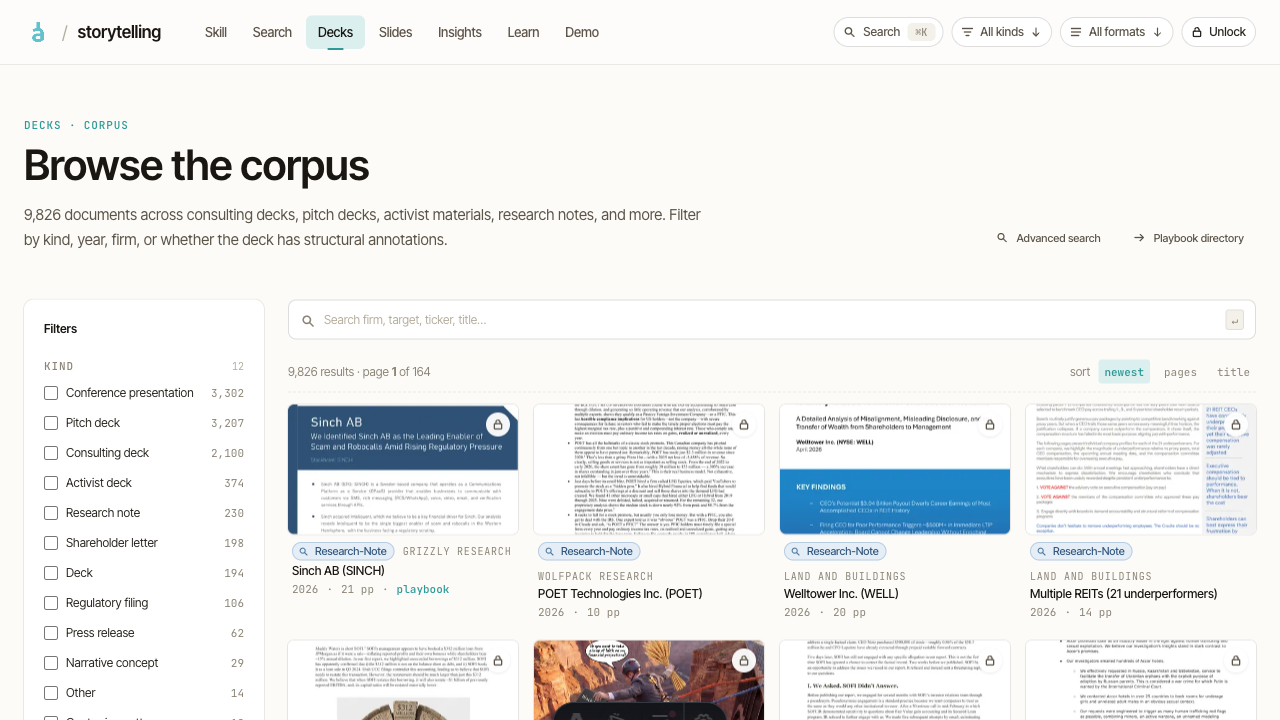 deck playbook viewer
Walk a deck slide-by-slide.
Every annotated deck plays back with arc beats, loop overlays and pattern callouts. The same playbook contract the MCP exposes as a tool.
-
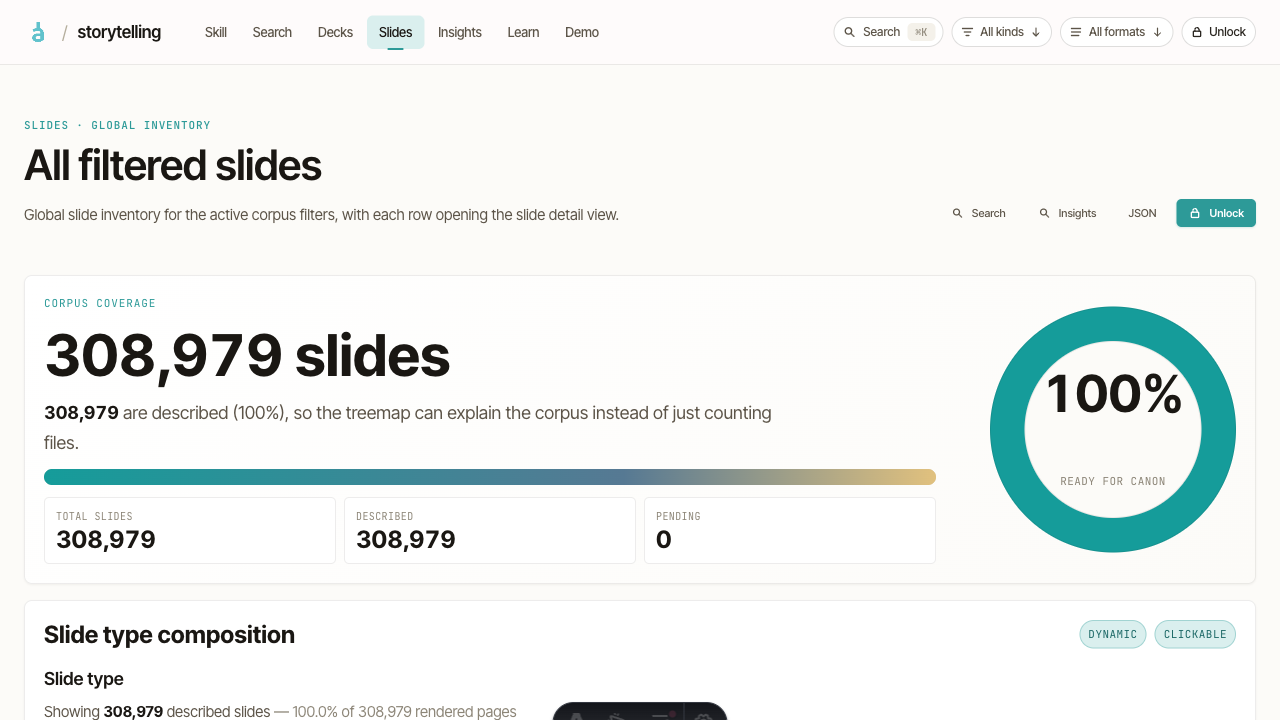 slide inventory
Browse 309k indexed slides.
Faceted by kind, function, slide type, components. Each slide carries the function and pattern tags your AI sees through the corpus.
-
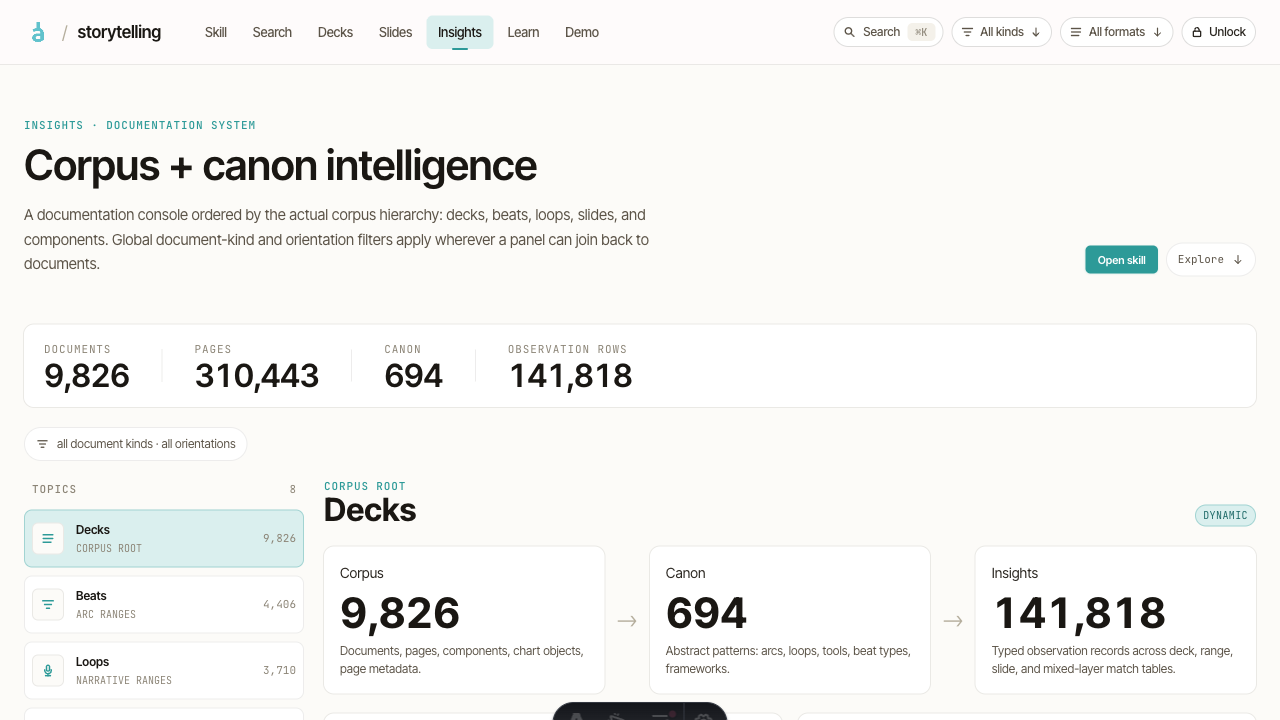 system insights
Cross-corpus distributions.
How patterns, arcs and frameworks distribute across firms, kinds and decades. Live SQL — same source `concepts.*` your agent queries.
-
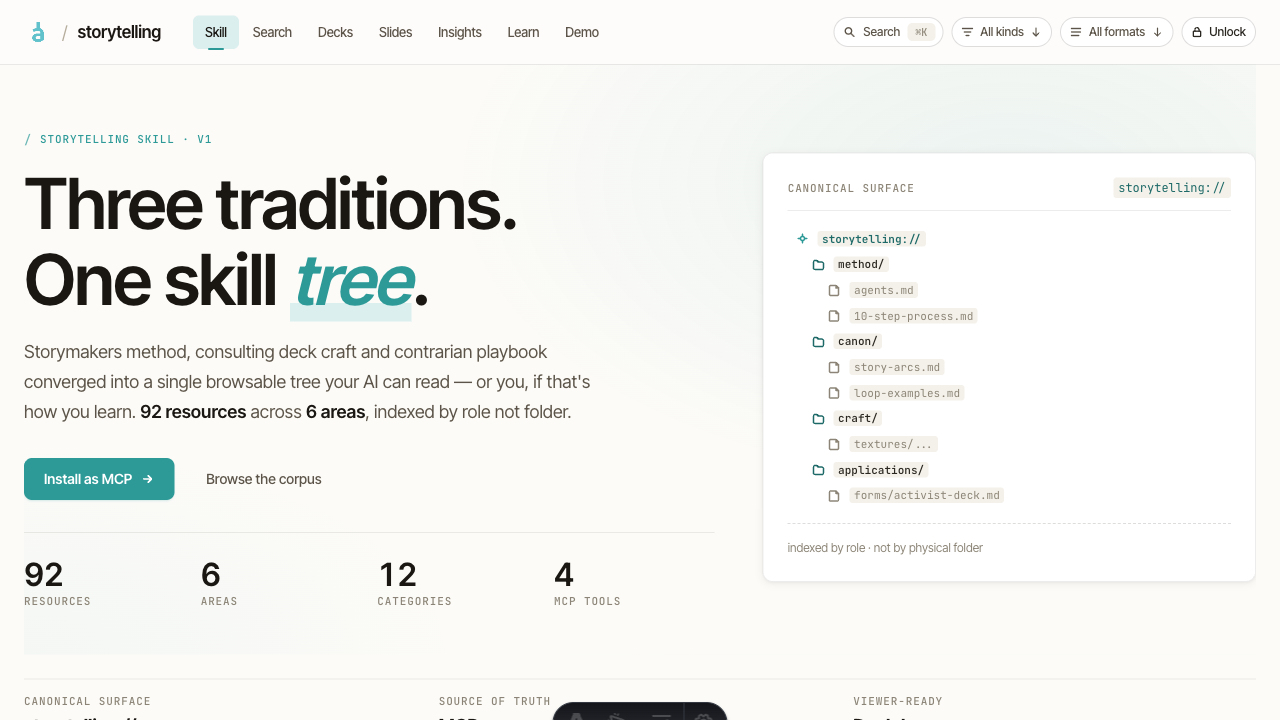 skill canon
Browse the skill tree.
The whole storytelling:// namespace, organized by role: method, canon, craft, applications, examples. The exact resources Claude reads.
-
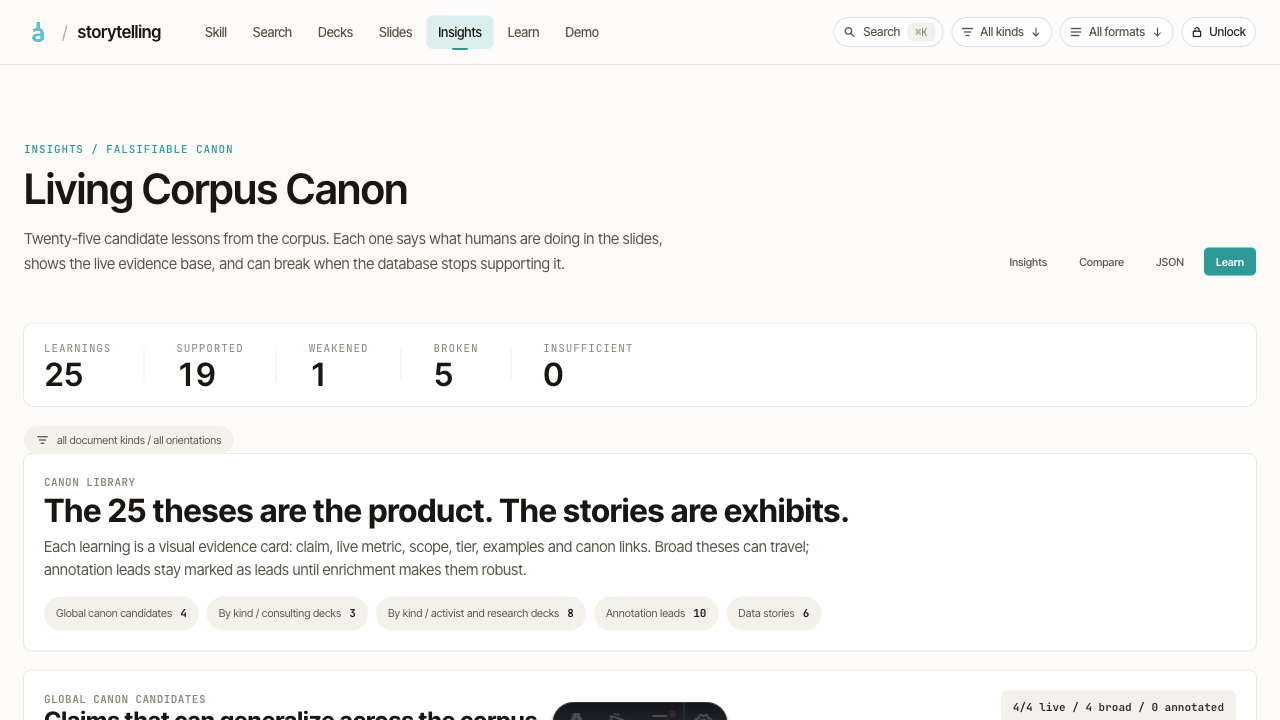 living canon
Falsifiable canon, evidence-backed.
25 candidate lessons from the corpus. Each carries its claim, live metric, and the slides that support — or break — it. The canon updates as the corpus grows.
-
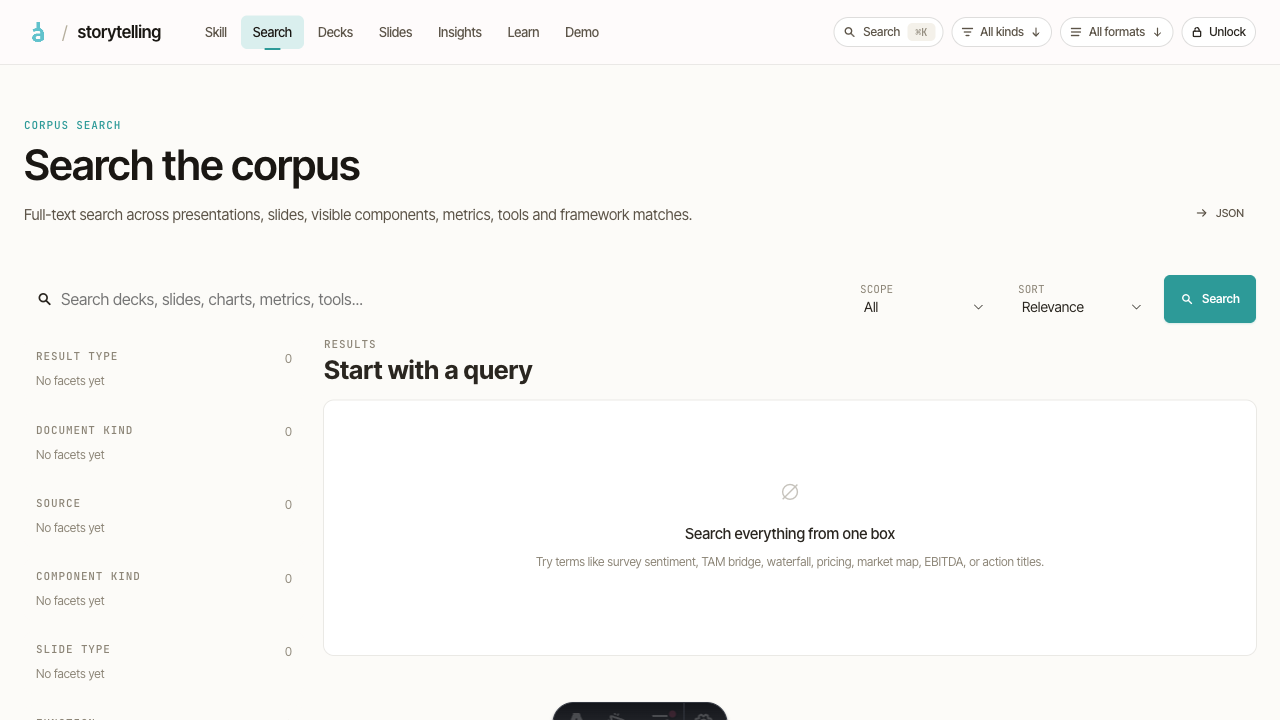 corpus search
Full-text + semantic search.
BM25 over slide text, components, canon entries. The web UI mirrors the `search_storytelling_corpus` MCP tool — same scoring, same hits.
Three steps. One AI superpower.
No sign-up form. No credit card. No marketing emails. One link, one command, and your next Claude session reads from 10.3k decks instead of guessing.
- 1
Tell us where to send your token
We email you one link. That's it. The token is revealed exactly once on the confirm page — your terminal, your secret.
Sealed-box encrypted SHA-256 hashed Revocable anytime - 2
Paste one line. Hit enter.
The confirm page hands you a single
npxcommand. The installer auto-detects Claude Code, Cursor or Codex and wires the MCP config. Idempotent.example$
npx @anlakstudio/storytelling-install a3f9_2e1b4d7c8a5e6f0b1c2d3e4f5a6b7c8d9 - 3
Ask. The MCP kicks in.
Restart your AI client.
storytellingshows up alongside built-in MCPs. Try the smoke test:Use the storytelling MCP to search for activist deck patterns.
The exact tools, resources and prompts your agent receives.
This panel polls the running MCP server every 3 seconds. What you see is what your Claude or Cursor session sees the moment you install.
Tools
25- pingPing
Health check: verifies the MCP is reachable and your token is valid.
- search_storytelling_corpusSearch the Storytelling corpus
Search the unified Storytelling skill corpus: method, canon, craft, examples and applied consulting/contrarian resources. The domain filter is a legacy source-family filter, not the public resource tree.
- get_storytelling_resourceGet a Storytelling corpus resource
Return the full markdown for one Storytelling resource. Prefer unified URIs like `storytelling://method/agents.md`, `storytelling://canon/story-arcs.md` or `storytelling://applications/forms/activist-deck.md`; legacy ids like `storymakers/meta/agents` still work.
- list_storytelling_corpusList the Storytelling corpus
List logical Storytelling skill areas/categories/resources. `domain` is kept only as a legacy source-family filter.
- get_storymakers_method_packGet the Storymakers method pack
Return curated Storymakers method markdown: overview, 10-step process, Creative Trio agents, checklists, story arcs, loop examples, examples, textures or all. This is the MCP-backed version of the Claude Storymakers skill.
- list_storymakers_canon_filtersList Storymakers canon filters
Presearch the available Storymakers request lenses before asking for canon or observed slide inventory. Document kind is the primary category lens; source/source_type is preserved as producer provenance/backcompat.
- get_storymakers_canonGet the Storymakers canon
Return the converged Storymakers canon: Postgres concepts.* is the source of truth for arcs, loops and tools, and MCP markdown resources are returned as companion bodies/examples. Call list_storymakers_canon_filters first when you need valid document kinds, layers, agents, slide types or component lenses.
- documents_count_by_kindCount documents by kind
Return the number of documents in the storytelling corpus (Postgres-backed) grouped by document kind. Documents with no classification appear under "unclassified".
- get_deck_playbookGet a deck playbook
Return the structured PlaybookDeck for one corpus document — slides, arc beats, loops, action titles, slide functions. Identifier accepts UUID or slug. Output is a compact prompt-friendly summary by default; pass format="json" for the full structure.
- search_slidesSearch slides
Faceted slice over corpus.page_metadata. `kind` selects the lens (slide_type, slide_function, component, chart, metric, tool, framework, arc, beat, loop, all) and `value` filters that lens. Document-level filters (kinds, sourceTypes, orientations) further narrow the scope. Returns up to `pageSize` rows (max 24).
- get_slideGet one slide detail
Return the full SlideDetail for one (docId, pageNumber) — components, metrics, framework/tool/arc-beat/loop matches. Use the `docId` from search_slides results.
- search_slides_semanticSearch slides by meaning
Meaning-first slide retrieval for deck-building agents. Describe the slide you need ("waterfall showing cost reduction across business units", "timeline of regulatory milestones with a call to act now") and get real corpus slides ranked by embedding similarity (cosine, text-embedding-3-small). Optional `document_kind` narrows to one kind (e.g. consulting-deck, pitchdeck, activist-deck); `entity_type: "deck"` searches whole decks instead of single slides. Follow up with get_slide({ docId, pageNumber }) or get_deck_playbook({ identifier }) for full detail.
- get_exemplarsGet exemplar slides
Return the N best real corpus slides for one canon lens: a tool (`tool_slug`), a slide type (`slide_type_slug`) or an arc beat (`beat_slug`). Pass exactly one of the three. Exemplars are ranked by match confidence and diversified (max 2 slides per document); each carries a signed image URL you can open as a multimodal input. Optional `document_kind` narrows to one deck kind (e.g. consulting-deck).
- get_narrative_priorsNarrative priors from the corpus
Aggregated narrative statistics for a slice of the enriched corpus (~10k docs): arc distribution, most common beat sequence, loop usage with typical open/close pages, SCQA completeness, example big ideas, audience×intent cross-tab. Pure SQL, no LLM. Filter by document_kind (e.g. consulting-deck, pitchdeck, activist-deck), audience (e.g. investors, executives), intent (e.g. persuade-decision, raise-capital) and/or author_name substring — at least one filter is required.
- get_layout_priorsLayout priors for a slide type
Where components sit on slides of a given type, aggregated from the corpus: per component kind, the share of slides that carry it, the median bbox (x,y,w,h normalized 0–1) with p25–p75 spread, and a verbal reading ("title: top band 5–12% of height, full width"). Filter by slide_type_slug (required, e.g. kpi_overview, executive_summary, section_divider), optionally document_kind and component_kind. Pure SQL over a bounded sample, no LLM.
- pressure_test_deckPressure-test a draft deck
Audit a draft deck against corpus priors — deterministic, no LLM. Four checks: title spine (all-caps, repeated openings, outlier lengths, stat stacking), arc coverage (deck vs the modal beat sequence of the document_kind, flagging missing beats), proportions (divider/evidence/assertion shares vs the kind median), and size (slide count vs p25–p75). Pass the deck as [{page, title, slide_type?, kind_hint?}] plus document_kind (e.g. consulting-deck) and optional audience/intent to narrow the prior.
- titles_examplesTitle examples by species
Fetch anonymized gold or flagged-bad examples for one of the 10 title species. Examples come from the 230k+ enriched corpus and are filtered against the species-specific gold criterion.
- titles_anti_patternsTitle anti-patterns
Pedagogical lookup of named title anti-patterns: definition, severity, and the canonical fix. Pass a slug for a single entry, omit it to list all 14.
- titles_species_cardTitle species card
Render one species ficha with live corpus data — same content as the `storytelling://copywriting/titles/species/<slug>` resource, exposed as a tool for callers that prefer the tools/call surface.
- titles_spine_checkTitle spine check
Audit a sequence of titles (in deck order) against deterministic wiring rules: all-caps share, first-word repetition, word-count outliers, stat-fact stacking, open/close echo. Returns a list of findings keyed by rule.
- titles_gradeGrade a draft title
Diagnose a single draft title against the species taxonomy, the three quality gates (headline / forward / 8-second), the 14 anti-patterns, and the pair pattern. Backed by `claude -p` (Opus by default; ~5–25s per call).
- titles_rewriteRewrite a draft title
Propose up to 3 candidate rewrites for a draft title. Each candidate must pass the three quality gates and be defensible by the evidence summary (if provided). The model declines when the evidence is too thin, returning a blocked_reason. Backed by `claude -p` (Opus default; ~10–30s per call).
- search_patternsSearch contrarian applications (deprecated)
⚠ Deprecated alias — will be removed 2026-07-01. Use search_storytelling_corpus({ domain: "contrarian" }) instead. Original behavior: BM25 search over the contrarian/activist application subset.
- get_patternGet contrarian application markdown (deprecated)
⚠ Deprecated alias — will be removed 2026-07-01. Use get_storytelling_resource({ id: "contrarian/<category>/<slug>" }) instead. Original behavior: read one contrarian/activist application markdown body.
- list_categoriesList contrarian application categories (deprecated)
⚠ Deprecated alias — will be removed 2026-07-01. Use list_storytelling_corpus({ domain: "contrarian" }) instead. Original behavior: list categories within the contrarian/activist application subset.
Resources
121applications/ 25
- follow-up.md — Campaign phase: Follow-up
- initial-thesis.md — Campaign phase: Initial thesis
- proxy-fight.md — Campaign phase: Proxy fight
- activist-deck.md — Form: Activist deck
- letter-to-board.md — Form: Letter to the board
- research-note.md — Form: Research note
- short-report.md — Form: Short-seller report
- activist-defense.md — Thesis: Activist defense (for management)
- breakup-spinoff.md — Thesis: Break-up / spinoff
- capital-return.md — Thesis: Capital return
- cost-cutting.md — Thesis: Cost cutting
- fraud-exposure.md — Thesis: Fraud exposure
- governance-board.md — Thesis: Governance / board
- management-change.md — Thesis: Management change
- multiple-rerating.md — Thesis: Multiple re-rating
- operational-turnaround.md — Thesis: Operational turnaround
- sale-of-company.md — Thesis: Sale of company
- strategic-pivot.md — Thesis: Strategic pivot
- undervaluation.md — Thesis: Undervaluation
- asset-value.md — Valuation: Asset value
- dcf.md — Valuation: DCF
- lbo-math.md — Valuation: LBO math
- multiple-comparison.md — Valuation: Multiple comparison
- precedent-transactions.md — Valuation: Precedent transactions
- sum-of-parts.md — Valuation: Sum-of-parts
canon/ 12
- loop-examples.md — Loop Examples — 30 Real-World Patterns
- story-arcs.md — Story Arcs Reference
- before-after-framing.md — Pattern: Before / after framing
- breakup-spinoff.md — Pattern: Break-up / spinoff
- ceo-quote-contradiction.md — Pattern: CEO quote contradiction
- fraud-exposure.md — Pattern: Fraud exposé
- governance.md — Pattern: Governance critique
- management-change.md — Pattern: Management change
- peer-gap.md — Pattern: Peer-gap chart
- precedent-transaction.md — Pattern: Precedent transaction
- sum-of-parts.md — Pattern: Sum-of-parts reveal
- villain-naming.md — Pattern: Villain naming
copywriting/ 12
- method — Titles — methodology
- spine — Titles — the spine (wiring across a deck)
- claim — Title species — The Claim
- category-label — Title species — The Label
- topic-headline — Title species — The Headline
- question — Title species — The Question
- directive — Title species — The Directive
- stat-fact — Title species — The Stat Drop
- vanity-statement — Title species — The Banner
- greeting-cover — Title species — The Marker
- quote-as-title — Title species — The Quote
- hybrid — Title species — The Hybrid
craft/ 10
- composition-patterns.md — Composition Patterns — Sequences That Work
- paragraph-textures.md — Paragraph Textures — Breaking Prose Monotony
- rhythm-rules.md — Rhythm Rules — Hard Constraints Against Monotony
- before-after-recipe.md — Slide recipe: Before / after
- closing-ask-slide.md — Slide recipe: Closing ask
- cover-slide.md — Slide recipe: Cover
- peer-gap-chart-recipe.md — Slide recipe: the peer-gap chart
- slide-architecture.md — Slide architecture: the 8-block sequence
- sum-of-parts-reveal-recipe.md — Slide recipe: Sum-of-parts reveal
- visual-craft.md — Slide visual craft
examples/ 1
method/ 58
- 10-step-process.md — The 10-Step Storymakers Process
- agents.md — The Creative Trio — Full Agent Reference
- checklists.md — Quality Validation Checklists
- README.md — Storymaking concepts
- action-title.md — Action title
- aha-moment.md — Aha moment
- arc.md — Arc
- audience.md — Audience
- beat.md — Beat
- big-idea.md — Big Idea
- block.md — Block
- claim.md — Claim
- closing-ask.md — Closing ask
- component.md — Component
- creative-trio.md — Creative Trio
- eight-second-test.md — Eight-second test
- forward-test.md — Forward test
- headline-test.md — Headline test
- loop.md — Loop
- mece.md — MECE
- narrative-axes.md — Narrative axes — Sense, Claim, Proof
- narrative-temperature.md — Narrative temperature
- opener.md — Opener
- plausibility-loop.md — Plausibility loop
- proof.md — Proof
- reasoning-approach.md — Reasoning approach
- reveal-strategy.md — Reveal strategy
- scqa.md — SCQA
- sense.md — Sense
- slide.md — Slide
- so-what.md — So what?
- tension-and-release.md — Tension and release
- vanity-quote.md — Vanity quote
- big-idea-formula.md — Big Idea Formula
- big-idea-formula.skill.md — Big Idea Formula — operational reference
- governing-thought.md — Governing Thought
- governing-thought.skill.md — Governing Thought — operational reference
- pyramid-principle.md — Pyramid Principle
- pyramid-principle.skill.md — Pyramid Principle — operational reference
- scenario-planning.md — Scenario planning
- scenario-planning.skill.md — Scenario planning — operational reference
- reveal-vs-headline-strategy.md — Reveal vs. headline strategy
- reveal-vs-headline-strategy.skill.md — Reveal vs. headline strategy — operational reference
- action-titles.md — Action titles
- action-titles.skill.md — Action titles — operational reference
- core-message-extraction.md — Core message extraction
- core-message-extraction.skill.md — Core message extraction — operational reference
- headline-test.skill.md — Headline Test — operational reference
- so-what-test.md — So What? Test
- so-what-test.skill.md — So What? Test — operational reference
- gallery-index.md — Gallery Index — Visual Components Reference
- playbook-example.md — Worked Example: AI Enablement Playbook (520 slides)
- audience.md — Storytelling: audience calibration
- closing-ask.md — Storytelling: the closing ask
- narrative-foundations.md — Narrative foundations (from the Storymakers methodology)
- primary-demands.md — Storytelling: primary demands
- scqa-framework.md — Storytelling: the SCQA backbone
- three-reasons.md — Storytelling: the three headline reasons
Prompts
4- draft-arcDraft an arc + beats for a thesis
Given a thesis and audience, suggest a Storymakers arc, primary beat sequence and one supporting loop, grounded in concepts.arcs and concepts.loops.
- review-deckReview a deck draft against the canon
Walk a deck draft through Storymakers checklists: action titles, narrative arc adherence, pattern coverage, slide function balance.
- storymakers-methodLoad the full Storymakers method
Bootstraps a session with the 10-step process, Creative Trio agents and quality checklists pre-loaded — for sustained authoring work.
- contrarian-thesisDraft a contrarian / activist thesis
Build a short or activist thesis using the corpus patterns: peer-gap, sum-of-parts, CEO-quote contradiction, governance, named villain.