

F 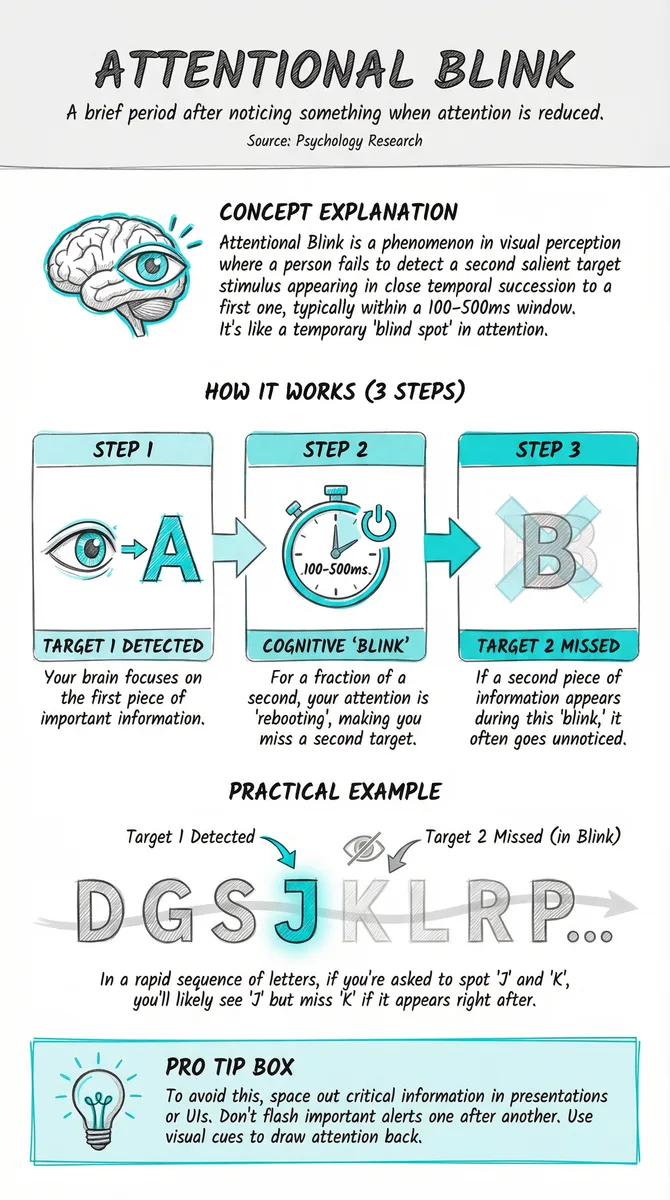
Slide · slide
Attentional Blink
attentional-blink 0 slide hits
Brief period after noticing something when attention is reduced
0 docs 0 slides/ranges n/a confidence
A navigable library for every canon family — arcs, beats, loops, tools, frameworks, slide types, functions, components, component subkinds and narrative concepts — with corpus coverage under the active filters.
Slide · slide
attentional-blink Brief period after noticing something when attention is reduced
Slide · slide
availability-heuristic Recent/vivid information weighted more heavily - use recent examples
Slide · slide
banner-blindness Users tune out repeatedly encountered content patterns - vary visual approaches
Slide · slide
bizarreness-effect Unusual material is remembered better than common material
Slide · slide
centre-stage-effect People tend to choose the middle option in a set - place preferred option centrally
Slide · slide
change-blindness Failing to notice changes when attention is elsewhere
Slide · slide
curse-of-knowledge-antidote Techniques to overcome expert blind spots: concrete examples, analogies, testing with novices
Slide · slide
decoy-effect Adding an inferior option makes target option more attractive
Slide · slide
default-bias People tend to stick with default options - make desired action the easiest path
Slide · slide
defensive-design Anticipating and designing for user errors and edge cases
Slide · slide
doherty-threshold Productivity increases when response time is under 400ms
Slide · slide
elaboration Connecting new information to existing knowledge improves retention
Slide · slide
endowment-effect People value things more once they own them - use 'your' language for solutions
Slide · slide
error-recovery Designing for easy recovery from mistakes
Slide · slide
figure-ground Designing clear distinction between foreground content and background
Slide · slide
fitts-law-corollary Infinite-width targets at screen edges are fastest to reach
Slide · slide
fittss-law Larger and closer elements are easier to interact with - prominence matters
Slide · slide
fluency-heuristic Easy-to-process information feels more true and trustworthy
Slide · slide
forcing-function Interaction design that prevents errors by forcing correct behavior
Slide · slide
f-pattern Designing for natural left-to-right then down reading pattern
Slide · slide
generation-effect Information is better remembered if generated rather than read
Slide · slide
graceful-degradation Maintain core functionality when features fail
Slide · slide
gulf-of-evaluation Gap between system state and user understanding - make state visible
Slide · slide
gulf-of-execution Gap between user intention and available actions - minimize it